
The Heart of a Dog
Overview
Mikhail Bulgakov’s The Heart of a Dog is a satirical novella, often described as science fiction, written in 1925 and set in post-revolutionary Moscow. It combines a fantastic medical experiment with domestic comedy and a sharp examination of political authority, social class, and the ambitions of those who believe society can be remade by design. The work could not be published openly in the Soviet Union during Bulgakov’s lifetime. It appeared abroad in 1968, while publication in the Soviet Union followed in 1987. Its delayed circulation became part of its history: readers encountered a lively comic story that also offered a pointed critique of contemporary Soviet life.
The novella begins with Sharik, a wounded stray dog trying to survive a bitter Moscow winter. Professor Philip Philippovich Preobrazhensky, a celebrated surgeon, takes him into his home. The professor is conducting experiments with human organs, hoping to investigate rejuvenation, and he transplants organs from a recently deceased man into the dog. The operation has an extraordinary result: Sharik gradually becomes a human-like being, given the name Polygraph Polygraphovich Sharikov. Yet acquiring a human body and speech does not make him thoughtful or humane. Sharikov is coarse, impulsive, and disruptive. He asserts himself in the professor’s household and becomes entangled with Shvonder, a housing-committee official whose ideas and political influence intensify the conflict. The professor and his assistant Bormenthal find their home and authority increasingly challenged by the creature their experiment has produced. Eventually, they perform another operation, and Sharikov returns to his former canine state.
Satire, science, and society
The transformation is at once a comic spectacle and a political parable. Bulgakov questions whether a person—or a society—can be improved simply by changing its outward conditions and assigning it a new identity. Sharikov’s conduct makes a mockery of the assumption that social transformation automatically produces education, responsibility, or moral development. The experiment also exposes the hubris of scientific intervention: Preobrazhensky’s technical skill does not give him control over all the consequences of his work.
The novel’s satire is directed especially at Bolshevik social engineering and revolutionary claims about equality, but it is not limited to a simple opposition between a refined professor and an unruly new man. Preobrazhensky’s privilege, his attachment to comfort, and his conflicts with the housing authorities also reveal the inequalities and competing claims to power embedded in everyday life. The apartment becomes a stage on which class, domestic privacy, bureaucracy, and political language collide. Bulgakov’s comedy lets these tensions emerge through interruptions, arguments, and the escalating disorder of a household rather than through abstract political lectures.
The author’s medical training gives the surgical premise a vivid professional setting, while the dog’s early observations lend the story an unusual, street-level view of Moscow. Its mixture of fantasy, grotesque humour, and recognizable social detail makes the speculative plot feel both ridiculous and unsettling. The novella belongs to a period of upheaval in which revolutionary ideals, new institutions, and ordinary questions of housing and authority were reshaping daily life. Bulgakov turns that setting into a compact thought experiment: what happens when technical power and political ambition outrun human understanding?
Reception and legacy
The Heart of a Dog remains one of Bulgakov’s best-known satirical works, alongside The Fatal Eggs and his much larger novel The Master and Margarita. Its suppression and delayed publication reflect the difficulty Soviet censorship posed for writers whose work challenged official assumptions. Today it is read as a comic fantasy, a critique of bureaucratic and political power, and a cautionary tale about attempts to engineer human nature. Sharik’s transformation into Sharikov continues to invite discussion of scientific ethics, class, identity, and the difference between changing a body and cultivating a person. The novella’s lasting achievement is to make those large questions inseparable from an absurd, memorable story.
About the Author
Early life and education
Mikhail Afanasyevich Bulgakov was born in Kyiv on 15 May 1891, when the city was part of the Russian Empire and is now the capital of Ukraine. He was the eldest child in a Russian family of seven. His father was a professor at a theological academy, and Bulgakov grew up with an interest in literature, music, and theatre. The literary world of his youth included writers such as Nikolai Gogol, whose comic grotesquerie and attention to the absurd would prove congenial to Bulgakov’s own imagination.
Bulgakov studied medicine at the University of Kyiv, graduating in 1916. During the First World War he worked as a doctor, first in hospitals and then in rural practice. He served in the Smolensk countryside and later worked at a hospital in Vyazma. The isolation, urgent cases, and practical demands of provincial medicine became material for the stories later collected as A Country Doctor’s Notebook. His medical background also gave his fiction a convincing knowledge of clinical work and the body, particularly apparent in The Heart of a Dog.
The revolutions and civil conflict transformed his life. Bulgakov experienced the upheavals in Kyiv and the wider disruption of the Russian Civil War. In 1919 he began turning away from medical practice toward journalism and literature. He moved to Moscow in 1921, where he worked to establish himself as a writer and dramatist. His experience of political instability and social breakdown informed The White Guard, a novel based on the turmoil surrounding Kyiv and a family caught in the conflict.
Writing and censorship
Bulgakov wrote novels, short stories, plays, and other prose, often mixing realism with fantasy, satire, and the grotesque. Among his important early works are the novel The White Guard, published in serial form in the mid-1920s; the novella The Fatal Eggs (1924), which turns a scientific discovery into a story of disastrous consequences; and The Heart of a Dog (1925), a satirical fantasy about a surgeon’s experiment and the social world around it. A Country Doctor’s Notebook, published in 1925, drew on his medical experience. Across these works, improbable events expose familiar weaknesses: vanity, bureaucratic interference, political dogmatism, and the gap between grand ambitions and human limitations.
His success as a playwright brought him into closer contact with Soviet theatres and censorship. Days of the Turbins, adapted from The White Guard, opened at the Moscow Art Theatre in 1926 and became one of his best-known plays. His stage career could not shield him from official pressure. From the late 1920s, his writing was increasingly criticized and blocked; by 1929, publication and production had become exceptionally difficult. Bulgakov appealed for permission to leave the Soviet Union, but remained in the country. He continued writing and worked in theatre, even as many of his literary projects were prevented from reaching the public in their intended form.
His major novel The Master and Margarita occupied much of the 1930s and remained unfinished at his death. It combines fantastic events in Moscow with historical and philosophical strands, and explores artistic freedom, moral choice, and the fate of the writer. It was published after Bulgakov’s death, first in a censored form in the 1960s, and later in a more complete edition. Like The Heart of a Dog, it demonstrates his ability to use fantasy not as an escape from reality but as a way of making reality newly visible.
Death and reputation
Bulgakov died in Moscow on 10 March 1940, aged 48. During his lifetime, censorship and political hostility kept important parts of his writing from readers and audiences. The delayed appearance of his major works helped shape his posthumous reputation: he came to be recognized as one of the most inventive Russian writers of the twentieth century, a master of comic satire and supernatural fiction as well as a penetrating observer of Soviet society. The Heart of a Dog and The Master and Margarita remain his most widely known works, while his plays and medical stories reveal the range of his writing. His work continues to be translated, staged, adapted, and debated for its treatment of artistic freedom, state power, social upheaval, and the limits of human attempts to control life.
StoryFlow
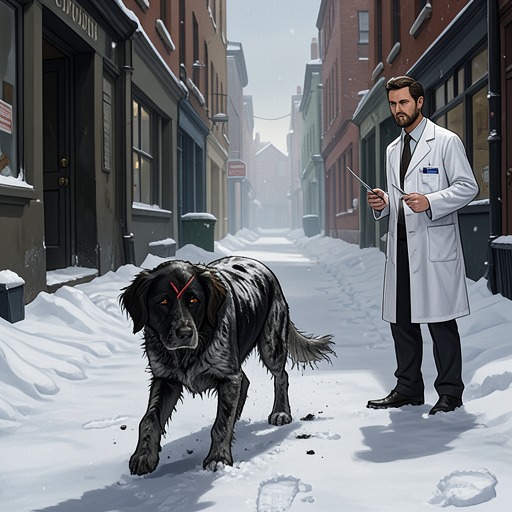
From Stray Dog to Experiment
This central transformation follows Sharik from a wounded street dog into a humanized being whose conduct exposes the limits of scientific creation.

The Scientist's Ambition and Retreat
This thread traces Professor Preobrazhensky's movement from ambitious intervention to sober recognition that scientific possibility does not establish practical wisdom.
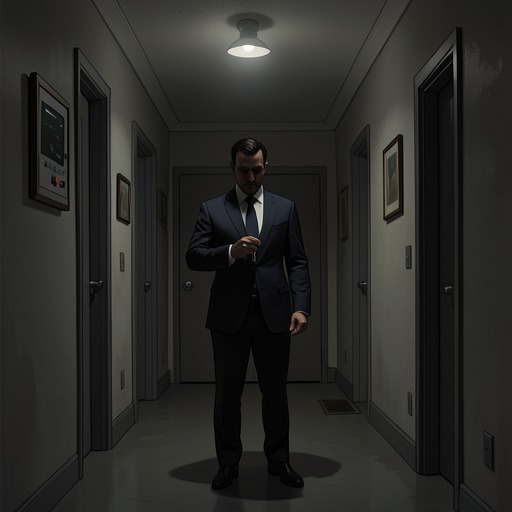
A Home Under Pressure
This main thread follows the security of Professor Preobrazhensky's household as institutional pressure and Sharikov's behavior progressively make domestic life precarious.
